INFERIOR VENA CAVA (IVC) FILTERS PLACEMENT AND RETRIEVAL
What are the endovascular placement and retrieval of an IVC filter?
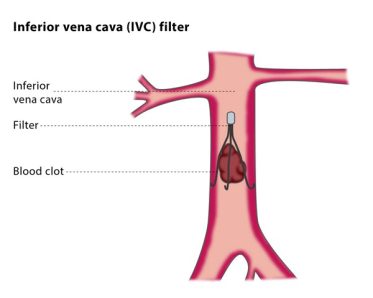
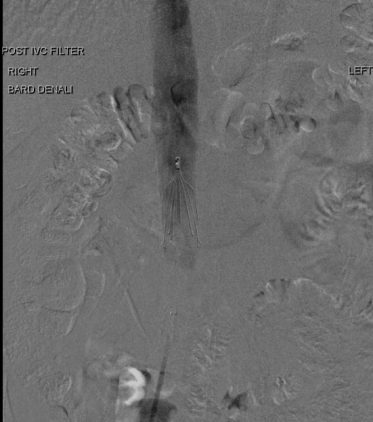
IVC filters are metal devices which are designed to be used in the inferior vena cava (IVC), the large vein that carries deoxygenated blood from the lower half of the body back to the heart.
A pulmonary embolus is a blockage in the main artery of a lung. IVC filters can be used to prevent or manage pulmonary emboli and deep vein thrombosis (DVT), and can be temporary or permanent. The shape of an IVC filter resembles that of an umbrella, and it functions in a similar way.
How does the procedure work?
The interventional radiologist will insert a 3 mm plastic tube (called a sheath) into the base of your skull or your groin. They will guide the sheath to the blood clot in the inferior cava vein, which is where the IVC filter will be placed.
If you receive a temporary IVC filter, the interventional radiologist will remove the filter after the necessary period of time has passed. To remove the IVC filter, the interventional radiologist will insert a long plastic tube and a goose-neck system (like a miniature lasso) as before and use this to remove the IVC filter.
Why perform it?
There are a number of treatments available to manage or prevent pulmonary emboli and DVT, including conservative (medical) therapy, IVC filters, intravenous systemic thrombolysis, catheter thrombolysis and a surgical operation.
Your suitability for this treatment depends on a number of factors, including how stable your blood pressure is and how well your heart is working. Other factors which will be taken into consideration are the type of IVC filter and your clinical situation, as permanent placement means you will need to take medication to prevent blood clotting for the rest of your life.
What are the risks?
There are some minor risks, including infection and bruising at the puncture site in your neck or groin. Major risks include the filter moving to another part of your body, the development of another thrombus, or a leg of the IVC filter breaking through the wall of the vein, which can be painful.
If you have a permanent IVC filter, the medication preventing blood clots that you will need to take carries further risks.
Benefits of IR guided procedures
141. Rapid relief from symptoms.
142. The imaging techniques allow accurate diagnosis and treatment using cutting-edge equipment. Diagnosis is reconfirmed during procedure.
143. Minimally invasive procedures are performed through a small hole in the skin, minimising the patient’s discomfort and recovery time. There won’t be any scar.
144. Most procedures can be performed on an outpatient basis or require only a short hospital stay. As interventional procedures tend to require only local anaesthesia, hospital stays are very short, with patients frequently going home the day the procedure is performed.
145. Patients who undergo IR procedures experience less pain during and after the procedure than patients undergoing surgical procedures. Post-procedural care is provided, along with follow-up imaging to confirm if the treatment has been successful.
146. Minimal damage to surrounding vital anatomical structures with no significant structural weakness.
147. No or negligible blood loss. No requirement of blood transfusion.
148. Return to work and other normal activities usually within the first few days after the procedure.
149. Low risk compared to surgery. The techniques can be used in very sick patients who are unfit for surgery.
150. Overall procedure is less expensive than surgery or other alternatives.
How will you prepare for procedure:
Procedure will be done as a day case procedure, only rarely would you need to stay overnight.
• You will have had some blood tests performed before the procedure to check that you do not have an increased risk of bleeding.
• You are asked not to eat for 4 hours prior to the procedure. You may drink a little water.
• You will need someone to drive you home and to look after you for 24 hours.
• You should be prepared to stay overnight if necessary.
• If you have any allergies or you have previously reacted to intravenous contrast medium, you must let the doctor know. Intravenous contrast medium is the injection we give you during some scans.
• If you are diabetic, please contact IR coordinator at 0328 0177770 for further information
• If you normally take any medication to thin your blood (anticoagulation or antiplatelet drugs) such as: warfarin / clopidogrel / aspirin, dabigatran (Pradaxa) / rivaroxiban (Xarelto) / Apixaban (Eliquis) / phendione / acenocoumarol – then these may need to be stopped or altered. Please contact the contact IR coordinator at 0328 0177770 for further information
How long will it take?
Every case is different, and it is difficult to predict exact time it will take. Procedure will be carried out in image guidance and roughly takes an hour or so.
What Happens afterwards?
You will be observed in a post operative facility for 2 to 4 hrs and if all observations are satisfactory, you will be discharged home the same day. It is natural to feel tired after the procedure and a light bed rest for a couple of days is recommended.