
- What is selective venous sampling?
- How does the procedure work?
- Why perform it?
- What are the risks?
- Bibliography
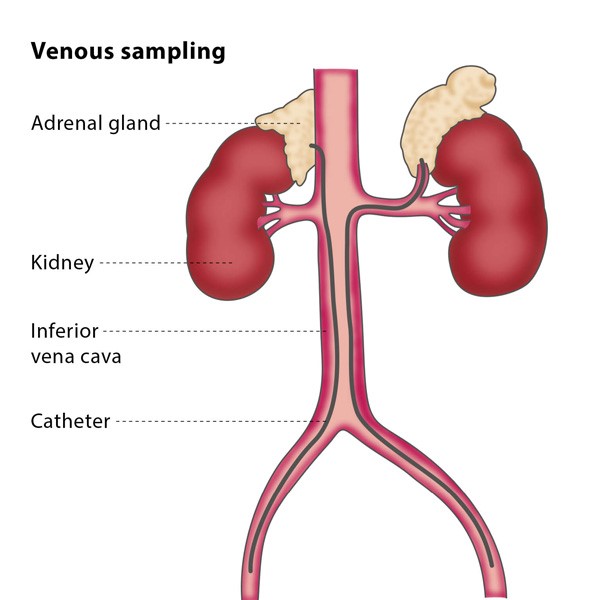
The interventional radiologist will insert a 2-3 mm catheter (tube) into a blood vessel in your groin and will then use imaging to guide the catheter to the selected area of veins. The interventional radiologist then takes some samples of blood from these veins, which are immediately analysed to check the levels of particular hormones and other substances.
Selective venous sampling is performed when it is suspected that a patient has a tumour but the doctors have been unable to find it using imaging, usually because the tumour is too small. The procedure allows surgeons to know precisely where the tumour is due to the level of hormones and other substances in the blood.
Selective venous sampling is performed when it is suspected that a patient has a tumour but the doctors have been unable to find it using imaging, usually because the tumour is too small. The procedure allows surgeons to know precisely where the tumour is due to the level of hormones and other substances in the blood.
- Viste K, Grytaas MA, Jørstad MD, Jøssang DE, Høyden EN, Fotland SS, Jensen DK, Løvås K, Thordarson H, Almås B, Mellgren G. Efficacy of adrenal venous sampling is increased by point of care cortisol analysis. Endocr Connect. 2013 Nov 15; 2(4):236-42.
- Sarlon-Bartoli G, Michel N, Taieb D, Mancini J, Gonthier C, Silhol F, Muller C, Bartoli JM, Sebag F, Henry JF, Deharo JC, Vaisse B. Adrenal venous sampling is crucial before an adrenalectomy whatever the adrenal-nodule size on computed tomography. J Hypertens. 2011 Jun; 29(6):1196-202.