TRANS ARTERIAL CHEMOEMBOLISATION TACE
WHAT IS LIVER TUMOUR?
The liver is a relatively common site for the development of primary cancers (hepatocellular carcinoma or HCC), and for the secondary spread of cancers from another site (often from colorectal cancers or other cancers in the body.)
What is a Transarterial Chemoembolisation (TACE)?
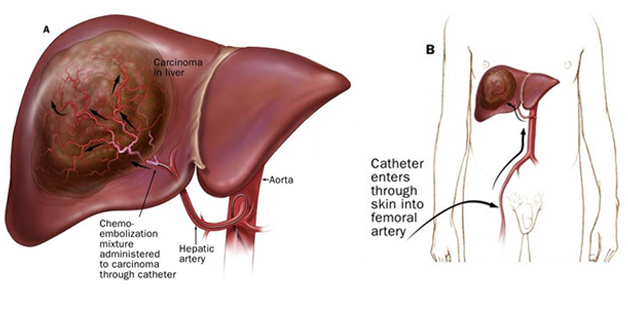
TACE is a treatment for liver cancer that uses a combination of chemotherapy (anti-cancer drugs) and an agent (small plastic beads) to block the blood vessels supplying the tumour (embolisation).
TACE works in two ways:
• it gives high doses of chemotherapy to the tumour (to destroy cancer cells)
• it reduces the blood supply to the tumour and so starves it of oxygen and the nutrients it
needs to grow
This treatment is usually used to control the cancer, rather than cure it.
Why do I need a TACE?
You will have been referred for this procedure because you have tumours in your liver. These may be from a primary cancer arising in the liver, or cancer spreading to the liver from somewhere else in your body.
Tumours can be treated in a number of ways, including chemoembolisation, radiotherapy and surgery. A team of specialists will have discussed your treatment plan and decided that TACE is the best option for you. You will have the opportunity to discuss this decision with the consultant radiologist.
Who will perform the procedure?
A specially trained doctor called an interventional radiologist will perform the TACE. Interventional radiologists have specialist expertise in using x-ray and scanning equipment, and in interpreting the images produced.
Radiographers and nurses will also be present in the room during the procedure. Because we are a teaching hospital, there may be some supervised students at your appointment.
How should I prepare for the procedure?
Pre-assessment appointment:
We will ask you to come in for a pre-assessment appointment, where we will perform some blood tests. These tests are to check that you don’t have an increased risk of bleeding, and that you are still a suitable candidate for the treatment.
Medication:
We will inform you during your pre-assessment appointment about which medications you will need to stop and which you can continue taking. If you are taking any of the following medicines, it’s important that you tell us at your pre-assessment appointment:
• Anticoagulants
• Antiplatelet drugs
• Aspirin
• Direct oral anticoagulants
We will give you an antibiotic and possibly a sedative before the procedure.
Food and drink:
Before the procedure, you will have to stop eating (nil by mouth) for a short period of time.
• Morning procedure - You will not be able to eat anything from midnight the evening before your procedure.
• Afternoon procedure - You will be able to have a light, early breakfast at 6 am on the
morning of your procedure, and then only water until 11 am.
Bringing someone with you:
You may bring a relative or friend to stay with you on the ward. However, they will be unable to accompany you into the x-ray room.
Staying overnight:
If this is your first TACE procedure, you will need to stay in the hospital overnight for observation. Please bring an overnight bag with you, including all the medications that you are currently taking.
If you need a further TACE procedure, it may be possible to have this as a day case. We will discuss this with you before your second admission to the hospital.
What happens during the procedure?
We will take you to the interventional radiology department on a trolley. Before we begin the procedure, we will insert a cannula (a thin, plastic tube) into a vein in your arm or your hand. Through this, we will be able to give you intravenous fluids, painkillers and sedatives (medication that makes you feel sleepy and relaxes you), if required. Once in place, you shouldn’t be able to feel the cannula.
We will then place monitoring equipment on you. We will clean the skin on your groin with antiseptic and cover the rest of your body with a theatre towel. We will inject some local anaesthetic into your groin. This may sting briefly before going numb.
We will then insert a fine tube called a catheter into the main blood vessel in your groin (femoral artery). We will pass the catheter along the artery to the main blood vessel that carries blood to the liver (hepatic artery). Through the catheter, we will inject some small beads containing chemotherapy medication into the small arteries feeding the tumour.
The procedure usually takes between one and two hours.
What happens after the procedure?
After the procedure, we will remove the catheter from your groin. To stop any bleeding, we will put pressure on your groin for 10 to 15 minutes.
We will then take you back to the ward. You will need to lay flat on your back for two hours. The ward nurses will monitor your blood pressure, heart rate and wound area. After four hours you will be able to stand up and start moving.
We will usually discharge you the next day.
The procedure will hopefully reduce the size of your tumour. We will perform a CT scan four to six weeks after your treatment to check if the procedure has been successful. If the tumour still has a blood supply, you may need further treatment.
Are there any risks or complications?
TACE is a safe procedure, but as with any medical procedure there are some risks and complications that can occur. These are outlined below:
Post embolisation syndrome
Immediately after the procedure, you may experience some flu-like symptoms. This is called post embolisation syndrome. You may also find that you have extreme tiredness (fatigue), which can last a few weeks. This is just the body’s way of healing itself and will get better with time.
Bruising
Immediately after the procedure, you may experience some flu-like symptoms. This is called post embolisation syndrome. You may also find that you have extreme tiredness (fatigue), which can last a few weeks. This is just the body’s way of healing itself and will get better with time.
Inflammation of the pancreas, gallbladder or stomach
It is sometimes difficult to accurately place the beads. If the beads aren’t inserted into the correct place, they can accidentally block off another artery, such as those supplying the stomach, pancreas or gallbladder (non-target embolisation). This can cause pancreatitis, cholecystitis or gastritis (inflammation of the pancreas, gallbladder or stomach).
Liver failure
This is a rare, but serious complication. If some of the liver surrounding the tumour dies, a liver abscess may form, which will need to be drained under a local anaesthetic.
Contact us
If you have any questions or concerns while you’re in hospital, please discuss these with the interventional radiology specialist nurse.
If you need any help or guidance within a week of leaving hospital, please contact the interventional radiology specialist nurse. If there are any causes for concern, these can be escalated to the interventional radiology team.
Once you have been discharged from the interventional radiology specialist nurse service, your usual link nurse will be informed. They will take over your aftercare and see you in your outpatient appointments.
Benefits of IR guided procedures
1. Rapid relief from symptoms.
2. The imaging techniques allow accurate diagnosis and treatment using cutting-edge equipment. Diagnosis is reconfirmed during the procedure.
3. Minimally invasive procedures are performed through a small hole in the skin, minimizing the patient’s discomfort and recovery time. There won’t be any scars.
4. Most procedures can be performed on an outpatient basis or require only a short hospital stay. As interventional procedures tend to require only local anesthesia, hospital stays are very short, with patients frequently going home the day the procedure is performed.
5. Patients who undergo IR procedures experience less pain during and after the procedure than patients undergoing surgical procedures. Post-procedural care is provided, along with follow-up imaging to confirm if the treatment has been successful.
6. Minimal damage to surrounding vital anatomical structures with no significant structural weakness.
7. No or negligible blood loss. No requirement for blood transfusion.
8. Return to work and other everyday activities within the first few days after the procedure.
9. Low risk compared to surgery. The techniques can be used in very sick patients who are unfit for surgery.
10. Overall procedure is less expensive than surgery or other alternatives.
How will you prepare for procedure:
If you have any allergies or you have previously reacted to intravenous contrast medium, you must let the doctor know. Intravenous contrast medium is the injection we give you during some scans.
• If you are diabetic, please contact IR coordinator at 0328 0177770 for further information
• If you normally take any medication to thin your blood (anticoagulation or antiplatelet drugs) such as: warfarin / clopidogrel / aspirin, dabigatran (Pradaxa) / rivaroxiban (Xarelto) / Apixaban (Eliquis) / phendione / acenocoumarol – then these may need to be stopped or altered.
• Please contact the contact IR coordinators at
• 0092 333 4557106 Mr Shakeel
• 0092 306 5216028 Ms Tasneem
• 00 92328 0177770 Mr Hammad for further information