
- What is percutaneous nephrostomy?
- How does the procedure work?
- Why perform it?
- What are the risks?
- Bibliography
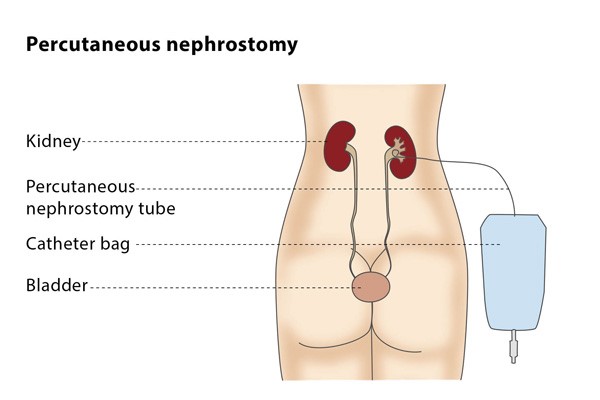
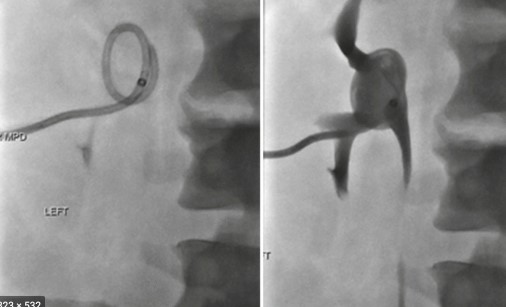
You will lie on your stomach, usually with one side slightly raised on a pillow. You will be given an injection of a painkiller and a sedative to reduce any discomfort. The area of skin around the entry site will be anaesthetised before the procedure.
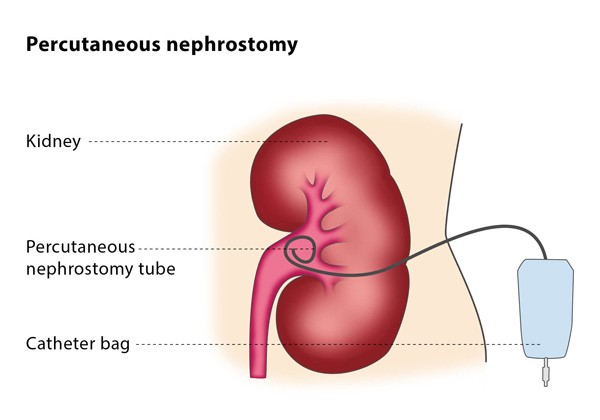
Under the guidance of ultrasound, X-ray or CT, the interventional radiologist will insert a needle through the skin and into the kidney and will then put a wire through the needle and insert the nephrostomy tube into the kidney over the wire.
You may be advised to have this procedure if the passage of urine to your bladder is blocked, most commonly because of a stone, infection, injury to the ureter or cancer. It can also be the first step of a procedure known as percutaneous/ante grade ureteric stenting.
Some patients report minor bleeding from the kidney after a nephrostomy. Severe bleeding that requires treatment occurs in less than 5% of patients. In less than 1/500 patients an adjacent organ is injured during the nephrostomy. Although temporary low-grade fever is common after the procedure, a high fever occurs in around 1-3% of patients, which is usually the result of an unresponsive infection.
- Ramchandani P, Cardella JF, Grassi CJ, Roberts AC, Sacks D, Schwartzberg MS, Lewis CA; Society of Interventional Radiology Standards of Practice Committee. Quality Improvement Guidelines for Percutaneous Nephrostomy. J Vasc Interv Radiol. 2003 Sep; 14(9 Pt 2):S277-81.