
If you are on any medication that prevents blood clotting, you will stop taking it before the procedure, if possible.
You should not eat anything for at least four hours before the procedure starts. During the procedure, a needle will be placed in one of your veins to make access easier during the procedure, and the medical staff will monitor you throughout the procedure.
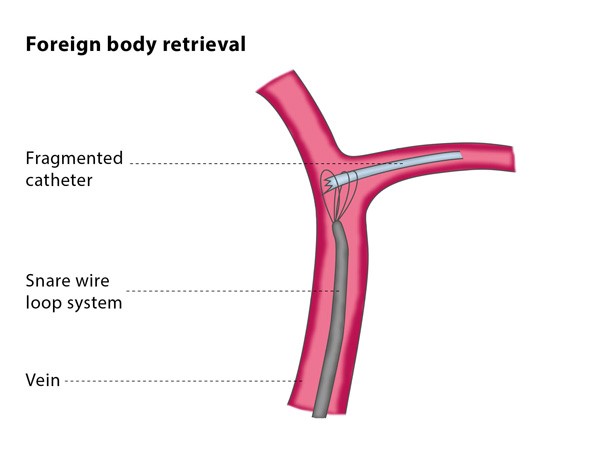
There are a number of reasons why you may be advised to undergo percutaneous foreign body retrieval.
There are a number of risks associated with foreign bodies, including septic complications due to bacteria on the foreign body, as well as the risk of dislocated stents and coils which may cause blood clots and restrict blood flow in the vein. Inferior vena cava filters and fragmented guidewires may pierce the wall of the vein, and cement fragments on soft tissues can be painful.
Possible vascular foreign bodies (in your veins) include a fragmented or badly positioned central venous catheter or an inferior vena cava filter, an arterial catheter or guidewire, or a displaced arterial stent or embolic materials (such as a coil or plug).
Possible non-vascular foreign bodies include displaced ureteral and biliary stents and catheters as well as cement fragments on the soft tissue.
The procedure may not be suitable for you if you have a blood-clotting disorder.
The rate of successful foreign body retrieval is very high – over 90-95% of endovascular retrieval attempts are successful. If the foreign body cannot be retrieved using a minimally invasive technique or your doctor thinks that an endovascular retrieval of the foreign body would be too difficult or too risky, your doctor may suggest the possibility of using the traditional surgical approach.